
Automotive Human Machine Interface Market Size to Reach USD 50.19 Billion by 2031, Driven by Connected Infotainment and Software-Defined Vehicles – Mordor Intelligence
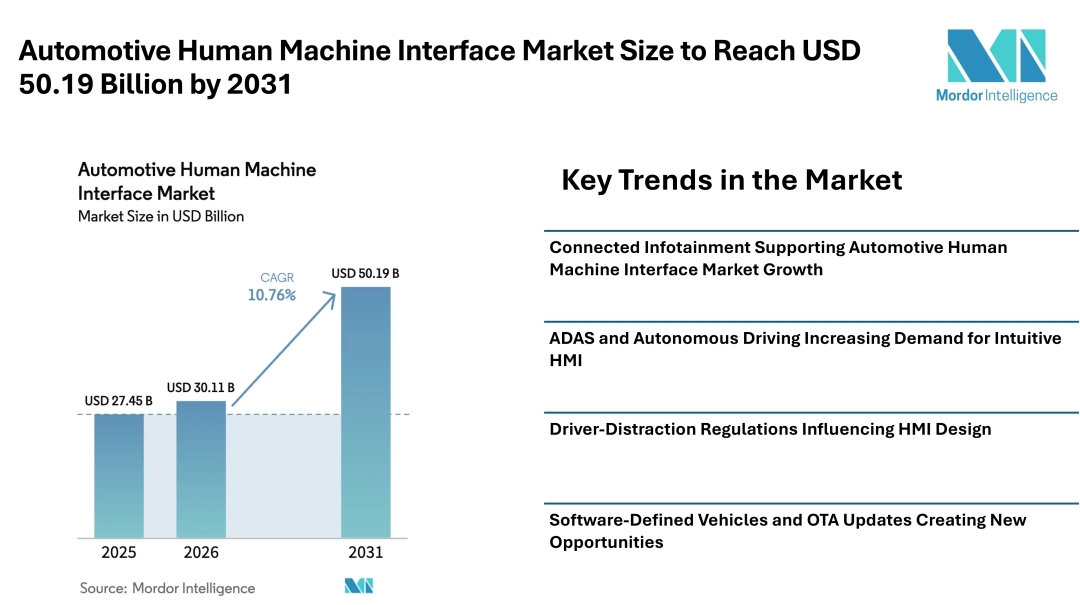
Hyderabad, 2nd September 2026: The automotive human machine interface market size is expected to grow from USD 30.11 billion in 2026 to USD 50.19 billion by 2031, registering a CAGR of 10.76% during the forecast period. The market was valued at USD 27.45 billion in 2025.
The automotive human machine interface market is evolving from conventional physical controls toward software-defined experiences spanning voice, gesture, haptic, and visual interfaces. Connected infotainment, ADAS, autonomous-driving technologies, and over-the-air software updates are increasing demand for intuitive and responsive in-vehicle interfaces.
Asia-Pacific accounted for the largest market share in 2025, while the Middle East and Africa is projected to be the fastest-growing region through 2031.
Key Trends Shaping the Automotive Human Machine Interface Market
Connected Infotainment Supporting Automotive Human Machine Interface Market Growth
The growing demand for connected infotainment ecosystems is strengthening the automotive human machine interface market. Consumers increasingly expect seamless connectivity between smartphones, home assistants, and vehicles, encouraging automakers to integrate voice control, cloud services, and advanced digital interfaces.
ADAS and Autonomous Driving Increasing Demand for Intuitive HMI
The growing adoption of Level 2+ and higher automated driving functions is increasing the need for intuitive human machine interfaces. HMI systems must clearly communicate vehicle status, takeover prompts, and driver-assistance information through audio-visual and other interaction channels.
Driver-Distraction Regulations Influencing HMI Design
Regulatory attention toward driver distraction is encouraging automakers and suppliers to develop interfaces that reduce visual and cognitive load. Head-up displays, physical controls, driver-monitoring systems, and simplified interaction methods are gaining importance as manufacturers seek to present essential information with minimal distraction.
Software-Defined Vehicles and OTA Updates Creating New Opportunities
The shift toward software-defined vehicles is enabling automakers to introduce interface improvements and new features through over-the-air updates. This transition is supporting recurring software-based feature upgrades while increasing the importance of secure and compliant HMI update processes.
Automotive Human Machine Interface Market Segmentation Analysis
By Product Type
- Central Displays
- Voice Control Systems
- Head-Up Displays (Conventional and AR)
- Touch-Sensitive Steering Controls
- Gesture-Control Modules
- Rotary/Knob Controllers
- Wearable and Bring-Your-Own-Device Interfaces
By Access Type
- Single-Modal
- Multimodal (Voice+Gesture+Touch)
By Interaction Modality
- Visual (LCD/OLED/micro-LED)
- Acoustic (Voice, Sound-Haptics)
- Haptic (Force-feedback, Ultrasonic)
By Vehicle Type
- Economy Passenger Cars
- Mid-Price Passenger Cars
- Luxury Passenger Cars
- Commercial Vehicles
By Propulsion Type
- Internal Combustion Engine (ICE)
- Battery-Electric Vehicles (BEVs)
- Plug-in Hybrid Vehicles (PHEVs)
- Fuel-Cell Vehicles (FCEVs)
By Sales Channel
- OEM-Installed Systems
- Aftermarket Retro-fits
By Geography
-
North America
-
South America
-
Europe
-
Asia-Pacific
-
Middle East and Africa
Automotive Human Machine Interface Market Key Players and Competitive Landscape
The automotive human machine interface market is moderately concentrated, with major companies competing through advanced displays, cockpit electronics, multimodal interaction technologies, software-defined platforms, and AI-enabled interfaces.
Key players include:
Continental AG
Visteon Corporation
Valeo S.A.
DENSO Corporation
Bosch GmbH
Conclusion
The automotive human machine interface market is poised for strong growth as automakers transition toward connected, software-defined, and increasingly automated vehicles. Demand for intuitive interfaces is being reinforced by connected infotainment, ADAS, autonomous driving, OTA upgrades, and driver-distraction requirements.
Asia-Pacific remains the largest regional market, while the Middle East and Africa is expected to record the fastest growth through 2031. The increasing adoption of multimodal interfaces, augmented-reality head-up displays, electric vehicles, and AI-enabled cockpit technologies is expected to create further opportunities for HMI suppliers.
Industry Related Reports
Automotive Robotics Market: The Automotive Robotics Market is projected to grow from USD 18.61 billion in 2026 to USD 35.82 billion by 2031, registering a CAGR of 14.01% during the forecast period. The market’s growth is driven by increasing automation in automotive manufacturing, rising demand for improved production efficiency, growing adoption of advanced robotic technologies, and the need to enhance precision, productivity, and operational flexibility across automotive production processes.
Automotive Artificial Intelligence (AI) Market: The Automotive Artificial Intelligence Market is projected to grow from USD 6.19 billion in 2026 to USD 18.16 billion by 2031, registering a CAGR of 24.03% during the forecast period. The market’s growth is driven by increasing adoption of AI-powered automotive technologies, rising demand for autonomous and connected vehicles, growing integration of machine learning and computer vision, and the increasing use of AI to enhance vehicle safety, efficiency, and driving experiences.
Get More insights: https://www.mordorintelligence.com/industry-reports/automotive-artificial-intelligence-market?utm_source=abnewswire
ADAS Market: The Advanced Driver Assistance Systems Market is projected to grow from USD 37.71 billion in 2026 to USD 67.38 billion by 2031, registering a CAGR of 12.31% during the forecast period. The market’s growth is driven by increasing demand for vehicle safety, rising adoption of advanced driver assistance technologies, growing integration of sensors and intelligent systems, and increasing regulatory emphasis on improving road safety and reducing accidents.
About Mordor Intelligence
Mordor Intelligence is a trusted partner for businesses seeking comprehensive and actionable market intelligence. Our global reach, expert team, and tailored solutions empower organizations and individuals to make informed decisions, navigate complex markets, and achieve their strategic goals.
With a team of over 550 domain experts and on-ground specialists spanning 150+ countries, Mordor Intelligence possesses a unique understanding of the global business landscape. This expertise translates into comprehensive syndicated and custom research reports covering a wide spectrum of industries, including aerospace & defense, agriculture, animal nutrition and wellness, automation, automotive, chemicals & materials, consumer goods & services, electronics, energy & power, financial services, food & beverages, healthcare, hospitality & tourism, information & communications technology, investment opportunities, and logistics.
For any inquiries or to access the full report, please contact:
https://www.mordorintelligence.com/
Media Contact
Company Name: Mordor Intelligence Private Limited
Contact Person: Jignesh Thakkar
Email: Send Email
Phone: +1 617-765-2493
Address:11th Floor, Rajapushpa Summit, Nanakramguda Rd, Financial District, Gachibowli
City: Hyderabad
State: Telangana 500008
Country: India
Website: https://www.mordorintelligence.com/


